
Three selves murmuring in ME
make I understand MY psychological doings
"Just as primary colors—red, green, and blue—can create every hue, the three selves—Ego, Superego, and Bio Id, as proposed by Sigmund Freud—collaborate to shape all our psychological processes. Each self has a unique role and emerges at different life stages, working together within our inner psyche to process and guide us.
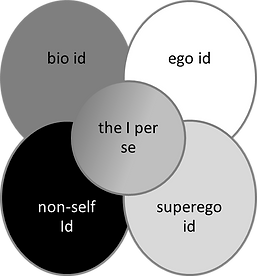
The triple selves are the core force of psychological activity. The three selves collaborate and work in synergy. Once the characteristics of the three souls are clearly defined, each of the three selves are clearly profiled, we can accurately understand and explain the inner psychodynamics. Each person's personality, thought patterns, behavior patterns, learning styles, and emotional regulation are all determined by the structure of the three souls. The three selves form the psychological structure of the "I" itself.
The I per se is the employer of the three selves. It is accepting the services from the triple selves and regulating the bio dynamics over the mind and body. The “I per se” experiences and engages in various psychological activities, such as consciousness, thinking, learning, behavior, and personal identity. The three souls shape the psychological dynamics that produce the experience of the “I per se”.
Examples: No matter what, any psychological activity is contributing by three selves’ collaborations.
-
Consciousness psychology: Bio id is reading bioinformation from within my body regarding my security and insecurity senses; telling ME what I wants and dislike; the Ego Id reads bioinformation from the external world, telling what I can do and how I will do; the Superego reviews historical information and tell ME what I should and should not do; then the I know what I feel.
-
Thinking psychology: thinking as an example. The bio-Id thinks in a dream-like and instinctive manner; the Ego thinks through linear language, reasoning, and rationalization pattern; and the Superego thinks through imagination and idealized meditative manner. Through the interaction of these three modes, the “I–ME” can think in multiple styles under in different circumstances, switching and alternating.
-
Learning psychology: Learning provides another example: the Bio Id learns from the processes of life itself; the Ego learns from the external environment; and the Superego learns from the spiritual mental realm. Through these processes, the “I–Me” becomes aware of the different facets of the life
-
Emotional management psychology: The Bio Id shapes one’s emotions; the Ego Id tries to express or suppress emotions; and the Superego refreshes the underlying mechanisms to generate new emotions. Once you understand the three selves' role in emotional management, you can enhance your emotional intelligence (EIQ) to promote your emotional management skills.
-
Personality psychology: The Bio Id presents impersonal, selfish traits; the Ego Id presents attention-seeking traits; and the Superego presents calm, balanced traits. Thus, my personality is shaped by balancing these three selves.


Contextualizing the identification of 5 spiritual members in integral cognitive frameworks
The identification of the 5 spiritual members in the human mind and bio logical unity is not rootless fabrication and irrational creation even it is not the consequences of visual dissecting procedures. You may find yourself skeptical about the existence of spiritual members as presented in the articles on this website. Indeed, the presence of spiritual members in the human mind is not definitively confirmed by modern biology or psychology. Spiritual members can only be meaningfully understood in the regulatory structures within the integral cognitive frameworks (ICF) when we undertake an integrated cognition of the human body, brain, and mind in tandem. The integral cognitive frameworks have four kinds of framed structures in Chinese biomedical models, including synergetic structures, regulatory structures, the ecological dissipative infrastructures and the biodynamic operational schemes.
The five spiritual ids are five regulators allocated in the four regulatory structures
Where do the five members of the spirituality come from? Their origin lies in the integral framework formed by body-mind integral cognition if you ever try to cognize the body brain and mind unity They are allocated in different structures of the ICF. The ICF is the cognitive results only to few people because we are unable to using brain to couple the body and mind, also unable to treat body-brain-mind as one cognitive target to cognize it which is the biomedical medicine in Chinses culture.
What the spiritual members do in the bio life unity
-
the 5 spiritual members are serving the fundamental structures of the conscious minds.
-
the 5 spiritual members are controlling components for the 4 regulatory structures of the bio logical unity
-
the 5 spiritual members are parts of the components building up the conscious and unconscious mind structures.
What is the four regulatory structures?
What is the integral cognitive framework/ICF?
the integral cognitive framework is the results of the integral construction that is sustained in cognitive performer' mind. It does not exist in the analytical cognition of the body and brain because analysis could only formulate fragmented stuff. It is only existing after the integral constructing procedures like what is constructed like a building. it is the cognitive results after the dividing and integrating procedures.
What cognitive methods are used to reach the ICF
With regard to the cognitive method, there are two cognitive methods to be used. The analytical cognitive approach and the integral cognitive approach.
-
The analytical cognitive approach: it is usually the procedures of dividing and subdividing procedures. it is used in visible and materialized cognitive object cognition. The cognitive process is typically about setting a cognitive object and then decomposing that object cognitively. the goal of the analytical approach is aiming to the understanding of the "structural components" and "functional activities".
-
The integral cognitive approach: The integral cognitive method is using analytical division and integrative construct two procedures. it is applicable to the cognition of multiple cognitive objects. It is employing both analytical division and integrative reconstruction two approaches. Analytical division is used to prepare materials for the second integral construct. This approach is central to the Chinese biomedical model, which uses the "integral cognitive method" to understand entire biological life entities. And integrative cognition is the cognition of the relationships between the analyzed objects. For example, neuroscience is the cognition of the brain, but the relationship between the brain, the body, and the mind needs to be separately understood using an integrative approach to recognize “roles” and “cooperative responsibilities” in teams.
To choose the cognitive methods is depending upon how the cognitive targets to be set
In fact, we often overlook the objects that are excluded when confirming that cognitive object, if the cognitive object is a single entity. But if the cognitive complex is multiple entities, such as a living being will use interdisciplinary integral cognition differing from single-discipline cognition. The switching of cognitive methods is very important. In fact, we do not know how to switch. Only when we understand the methods of multidisciplinary cognition can we consciously switch. This task of switching cognition is different. Single-discipline cognition uses an analytical method to understand “structure and function,” while multidisciplinary cognition uses an integrative method to understand “roles and functions.”
Contextualizing the identification of 5 spiritual members in integral cognitive frameworks
The identification of the 5 spiritual members in the human mind and bio logical unity is not rootless fabrication and irrational creation even it is not the consequences of visual dissecting procedures. You may find yourself skeptical about the existence of spiritual members as presented in the articles on this website. Indeed, the presence of spiritual members in the human mind is not definitively confirmed by modern biology or psychology. Spiritual members can only be meaningfully understood in the regulatory structures within the integral cognitive frameworks (ICF) when we undertake an integrated cognition of the human body, brain, and mind in tandem. The integral cognitive frameworks have four kinds of framed structures in Chinese biomedical models, including synergetic structures, regulatory structures, the ecological dissipative infrastructures and the biodynamic operational schemes.
The five spiritual ids are five regulators allocated in the four regulatory structures
Where do the five members of the spirituality come from? Their origin lies in the integral framework formed by body-mind integral cognition if you ever try to cognize the body brain and mind unity They are allocated in different structures of the ICF. The ICF is the cognitive results only to few people because we are unable to using brain to couple the body and mind, also unable to treat body-brain-mind as one cognitive target to cognize it which is the biomedical medicine in Chinses culture.


what roles are played by brain among the body brain and mind unity?
Brain is defragmenting the body and mind to facilitate the integral cognition:
The brain is just the brain; how to understand the brain is not the issue. The issue is how to define the role of the brain between body and mind, namely, how to understand the brain' relationship with the body and mind so that we can cognize the body brain and mind integrally and jointly. This is a question that few people raise, but it is very important question involving the intersections of philosophy, neuroscience, and psychology.
-
The first viewpoint treats the brain as one system of the body—that is, the brain acts as a regulator of the body.
-
The second viewpoint emphasizes that the brain and the mind are different. The mind depends both on the brain and the body; this is a view from neuropsychology.
-
The third viewpoint sees the brain as the coupler between the body and the mind, the facilitator of the mind.
-
the brain is the regulator of the human body, while the spirituality is the controller of the bio life.
these conclusive viewpoints not from the cognition of the brain per se; but from the multidisciplinary study of the brain body and mind.
First, recognize biological unity by adding two metaphysical layers to the physical body and brain, making a total of four layers to serve as the targets of analysis where the brain is body and mind coupler and mind facilitator make the addition possible.
After clarifying the roles of brain played in human life, the gap between body and mind will be filled, body and mind will be linked up for the possible integral cognition. The entire life entities should be cognized integrally or conjointly.
The procedures to get the integral cognitive frameworks
The procedures to build up the ICF
we will follow the proper procedures to bring the 5 spiritual members to the integral cognitive frameworks to show the origination of the spirituality.
-
defragmenting the body and mind by upgrading the viewpoints about brain to facilitates the integral cognition of the body and mind. In terms of cognitive targets, the body and mind must be rationally integrated by the brain; otherwise, a fragmented body and mind cannot be fully comprehended as a whole.
-
analytical dividing and subdividing the four layers of the bio logical unity to produce 4X4 synergistic blocks. Primary division and secondary subdivision are the cognitive analytical protocols used in each of four layers bio logical unity. It is producing the 4X4 matrix that is for future integrative constructive procedures.
-
integrally constructing the regulative framework: primary integration and secondary integration. the construction of the regulatory structures. The regulatory structural integration of combining the controller and the controlled.by interlinking the 4 synergetic sets of the four layers to build regulation structural frames
-
integrally constructing 2 infrastructural schemes:
-
the construction of the concentric dissipative ecological infrastructure. The integration of four networks as ecological ecosystem structures for message dissipation.
-
the construction of the biodynamic schemed modes.
-
What's in the Frameworks: the integral cognitive framework of human being is a compounded structural pattern after the complete cognition of the four layers. The compounded integral framework include the synergetic frame structures, the regulative frame structures, the dissipative ecological framework, and the biodynamic operational scheming pattern.
2 structural frameworks:
-
the synergy structural framework,
-
the regulatory framework,
2 infrastructural frames
-
the ecological dissipative infrastructural framework,
-
the biodynamic conjugational framework.
As a result, after these integrative processes, the final product is an integral cognitive framework—an outcome of this holistic cognition—wherein both the mind and spirituality can be situated within multiple layers of this framework.

Allocating the spiritual components in the four regulative frames of the integral cognitive frameworks
As we immerse ourselves in these integral cognitive frameworks, the location of spiritual ids will be revealed. Thus, to validate the existence of human spirituality, we must embed rationality within this framework, diving deep into the integral framework model, which is the ultimate cognitive outcome of the integration of body, brain, and mind. Of the four constructed regulatory frames, the five spiritual ids are located in the tiptop of the frame as controllers. in the cognition procedures of the 5-spiritual member, it is put in the regulatory structures, correlating the controlling spiritual id with the underlying controlled mind, brain and body.
-
the ego geared regulatory structure
-
the superego regulatory structure
-
the bio id geared regulatory structure
-
the non-self id geared regulatory structure
-
the top blue color is the spiritual member as controller
-
the second layer dark green is the mind platformer that is the mind workstation used by the controller
-
the 3rd orange red is the cerebral that is the justifier of the body, coupler of the body and mind
-
the bottom dark blue is the body being the controlled
in the four regulative frames structures, the role of the spirituality and role of the brain is separated, identified and defined.
The five spiritual members are representing the four regulative structures in collaboration in four biodynamic rhythmic modes. The living rhythm is defined as four phases, the I daytime working phase and II daytime resting phase: the nighttime dreaming sleeping III phase and nighttime IV dreamless sleeping phases. The four regulatory structures are allocated in the four phases; they are in operation in synergetic mode: in I phase, all four regulatory structure is dominating the phase, the rest of the three regulatory structures are in supporting services. in II phases, the superego regulatory structure is dominating, while the rest of two structures is in supportive services. in the III phase, the bio id is dominating and dreaming sleeping: while the non-self id geared structure is in supporting service: in the IV sleeping phases, only the non-self regulatory structure is in solo operation, rest of the three are all in sleeping. only the "I per se" gear no regulatory structures, but is the epic center, residing in the daytime conscious mind.
That is why that the first medical book in Chinese history called "灵枢 literally pivot of spirituality". define the 5 software apps as the center of the biomedical book.
Without the proper identifications of the 5 spiritual members, there is no way that regulatory frames could be constructed.

The synergy and regulative structures in the integral cognitive framework

the 5 spiritual members allocated in the 4 regulatory structures

Spiritual controllers and cerebral regulators/Is the brain or spiritual members life regulator/controller?
is the brain or the spiritual member the regulator of the body and mind, regulator is either controller or controller? brain is regulator of body? then who is controller of myself?
The answer is that the brain is the justifier-imbalance regulator调节者 of the body while the spirits is the master controller-control the physical movement and psychological activities控制者 of the body and mind.
in the regulative structure of the bio frameworks, the spiritual member becomes the controller, the brain role in life subsiding to supportive role, rather than the controller in the body and mind unified life unity. the adjusting role and controlling role have to be differentiated.
Thus, each of the four regulative structures is consisted of the top controller, the mind platformer, the brain coupler and regulator and the bottom body regulated.
if the body is the regulated, then brain is the regulator; if the entire life entity is concern, the spiritual member is controller, half body and half mind is the controlled. the brain is becoming the body adjuster; and mind facilitator.

Helping us to rationalize spirituality.
in the frameworks, spiritual member is treated as controller, the brain as justifier, but not used as single regulator.
However, it will take a long journey to reach the point that the integral frameworks being obtained, moreover, we have to develop the integral cognitive method to establish the integral frameworks. If we continue to use the systematic analytical cognitive methods, we could only cognize the materialized body and brain, unable to take and mind and spirituality into the consideration.
Why "integral" is so critical?
integral is critical term used in cognitive sciences, in the cognitive targets, in the cognitive methods and in cognitive outcome. It is opposite term like systematic and scientific. construct instead of analytical
simply cognize the hardware, not combined with the software; simply using the dividing cognitive protocol such as dissection, not using the combined analytical followed by reassembling constructing procedures. simply resulted in the human body model or integral cognitive frameworks.
-
The combined cognitive targets: physical hardware and metaphysical software. not only the physical targets such as body and brain being cognized, but also the metaphysical target such as spirituality and mind being cognized. The four layers of bio logical unity. Not cognize the targets one by one using different method; but integrate the targets together then using same method to cognized integrated cognitive target.
-
The combined cognitive methods, the analytical cognitive protocols being used, the integrative cognitive protocols also being used, thus methodologically integral. cognitive analytical and integrative protocols. Cognitive protocol is divided into two, the initial analytical procedures like to collect building materials or dismantle of the car; the integrating constructive procedures like assembling the car.
-
The combined cognitive outcomes: the analytical cognitive outcome such as systematic structures of human body like anatomical knowledge. in integral biology, the compounded integral frameworks, which including the synergy structures, regulative structures, ecological structures, and biodynamic structures, as 4 frames compounded to bio life frameworks. The integral cognitive framework is mentioned only in Chinese biomedical model, not involved in the western biomedical model.

Defining the academic disciplines in integral cognitive sciences
In scientific cognition of human body and brain, the definition of analytical biology is divided into system biology, cellular biology and macular biology, such as anatomy, physiology etc..... However, in integral cognitive sciences, for the integral cognition of human body brain and mind in the analytical and integrative combined protocols, the definitions of the academic disciplines are different. The integral psychology, the integral psychobiology, the integral biology, and integral bio cognitive sciences.defining the academic disciplines in biological unity cognition under integral cognitive sciences. the integral psychology, integral psychobiology, and integral biology within the Chinese biomedical model.

The integral bio cognitive sciences:
cognitive methodological exploration. not the direct study of the designated cognitive target.
is the study of the cognitive methods for the integral cognition of the body brain and mind. It is entitled “integral” because of the three perspectives of “the combined "cognitive methodological study to cognize the physical and metaphysical, software and hardware targets of bio life, how to cognize the body brain and mind where the brain is facilitating the integral cognition because it is coupling the body and mind.
programming the procedures how to cognize the integral cognitive target, how to carry out the integral cognitive protocols.
The analytic bio cognitive sciences: in the western biomedical model, the biology is the study of the life hardware cognitive targets, namely the cognition of the body and brain.
For cognition of the body and brain in modern biology and medicine, the anatomical analytical cognitive protocol is used, not using the integral constructing cognitive method. This is not don’t want, but don’t know how.
In the real human body, the system structures have existed, but don't need cognitively constructed. It is nature structures, for cognitive purposes, we just need to anatomically observe them and remember them.
there are another two biology being defined the cellular and molecular biology in the microscopic level about the body and brain. the cognitive method used for the biological cognition is analytical protocols. because the cognitive targets are materials and visual based, the cognition is structurally analytical and functionally analytical. no integrating procedures is involved in the cognitive procedures. all procedures are manually maneuverability.
About structure and structuralize
system structure is the only structure that is bearing by the cognitive targets, also by the cognitive performer as well as structured model.
synergetic structures and regulative structures are structures not bearing by the cognitive targets but constructed as cognitive frames or frameworks by the cognitive performers. only existed in cognitive performer' mind.
For the synergy and regulative structures, we have to analyze the body brain and mind to construct the synergy structures, then using the analytic synergetic blocks to build up the regulative structures. the construction of these structures in the integral frameworks demands that the mind be involved in the cognitive process.
The frameworks in the mind and mathematical model
The combined cognitive outcomes: the analytical cognitive outcome such as systematic structures of human body like anatomical knowledge; but also, the compounded integral frameworks, which including the synergy structures, regulative structures, ecological structures, and biodynamic structures, as 4 frames compounded to bio life frameworks. The integral life framework is mentioned only in Chinese biomedical model, not involved in the western biomedical model
These are the methods that Chinese Daoist biomedicine used to understand life.

The integral biology:
includes multiple disciplines in Chinese medical foundation. The successful cognitive outcomes about the integral cognitive targets by using combined analytical plus integrative cognitive methods. The formulation of integral life framework is the goal of integral biology. There are four structural frameworks, the synergy, regulatory, ecological and biodynamic structures built up. It is the biology foundation for Chinese medicine.


The integral psychobiology
is the sum of the study of the conscious and unconscious mind. the courses offered in this website is the studying results of the conscious mind, mainly in the psychology area. It is the study of the conscious minds where three souls are serving the I per se to accomplish all psychological activities as pragmatic psychology. The other part is the study of the unconscious minds where the non-self id is the focus, which is mainly in the area of psycho influences to the physiological body.
the study of the mind structures and functions in the contexts of integral cognitive biology and cognitive sciences
the integral psychology
the study of the mind structures and functions in the contexts of integral cognitive biology and cognitive sciences
The spiritualism psychology:

The integral psychobiology:
The Id, ego and superego are three selves or souls proposed by Freud. Everybody has three selves or soul born at different life stages. Each of the three selves has its own complete and comprehensive profiles. The three selves are murmuring inside of “ME”. They are collaborating to do all kinds of psychological activities for the “I” per se. Namely, any of psycho activities could be contributed and explained by three selves or by combination of the three selves.
-
The Id is bio self. It is telling what “I” want and not wanted. Life security sensor and defender. It is instinctual and habitual performer. It takes care of the inner life matter……
-
The ego self is message encoder for outfacing
-
The superego self is
At the same time, there are two spirits that Freud missed.
-
The “I” per se is the general manager of life matter. Three selves are synergetic working for “ME”. It is driving the voluntary half of body and mind…..
-
The Non-self is the “God” that is always within inside of your life, in charge of the bio stability to keep the internal organs working properly for you all time….
The spiritual psychology is analytical and integral cognition of the five spiritual ids that they are 5 faculty members in our mind facilities. They are like 5 software apps installed in our mind, overriding our brain and body to sensing and driving the hardware. This is alternative tooling for behaviorism psychology where the visible behavioral data are collected and then to guess what is going on in our mind. The spiritualism psychology is directly telling us any of the three selves is problematic.
Furthermore, spiritual psychology is part of the integral biology. The integral biology is biology that treat the body, brain, mind and spirituality four layers as intrinsic parts of bio life. All four layers are needing to be cognized coherently and integrally. After the cognition, the integral bio life frameworks have to be built up. The spiritual psychology is contextualized by integral biology which is the biology base in Chinese biomedical models.
Courses
This is the courses lists. It's a great place to preview and select the courses to take. The courses are organized into two programs, the mind precognition program and psychology cognition programs, total 6 sections. 1-5 sections as mind precognition program, the 6 sections as psychology cognition programs

the profile of the Bio Id
-
Birth and development,
-
messages responsibility/inner feeler,
-
needs and desire teller,
-
predictive urge foreteller,
-
life gratification weigher & emotional setter,
-
emotional tangle alleviator,
-
affection executor.
-
Bio security surveillance monitor,
-
bio life defender and healer,
-
emotional manager,
-
intuitive dreaming thinker,
-
impersonal trends,
-
instinctual intelligence,
-
wordless memories,
-
correlation with body,
-
correlative with vegetative neural networks,
-
correlative with unconscious mind,
-
in spiritual regulative teams

the profile of Ego Id
-
Outfacing agent
-
the outer feeler
-
birth and development
-
language master
-
external messages symbolizer wording encoder
-
outer objects identifier external world cognitive performer
-
rational message information knowledge processor
-
[behavioral reactor: planner and implementer]
-
[realistic wording thinker]
-
[mankind personalizer]
-
[intellectual instinctual intelligence agent]
-
[alliance to bio id]
-
[Ego id with 5 senses from 5 sensory organs]
-
[Ego id with neocortex and forebrain subcortical circuitries]
-
[Ego and conscious mindset]

the profile of Superego id
Birth of supereg
showtime of sup,
historical data processor, consciences producer,
using consciences to manage peers,
sensing the spiritual world,
right or wrong teller
philanthropic intelligences, moralizing capability,
peer knowe,
peer discipliner
, peer dignifying agent
peer neutralizer
peer interlink agent
humanizer
dimensional imaginary thinker spiritual world reader
social role identifier
behavioral optimizer
correlation with frontal lobe and reproductive system
dominating the subconscious mindsets


the profile of the I per se
Describe the item and include any relevant details. Click to edit the text.


the profile of the non-self id
The fulltime bio stabilizer Intelligence coder and supplier Running the solipsistic life domain Teaming up with other spiritual figures Three versions of non-self Id The intrinsic biological God The extrinsic religious God Biology Philosopher


the pragmatic psychologies cognition programs
-
the thinking psychology
-
the learnability psychology
-
the EIQ psychology
-
the personality psychology
-
the regulation psychology
-
behavioral psychology
Dr Liang, Zhenwen/Kevin MD, PhD
Neuroscientist
upgrading his viewpoints about brain at different life stages.

In the 1980s, I began my university education in medical school, studying anatomy, physiology, and related biomedical sciences. At that time, I was taught that the central nervous system is one of several parallel systems in the body, and that the brain functions as the regulator of the body’s physiological activities within the framework of systems biology.
Viewpoint I: Brain = one system of the body= regulator of the body
During the process of obtaining my Master’s and PhD degrees in neuroscience, I was continually perplexed by the distinction between the structure and function of the brain and mind. I came to believe that mental activity arises from the operation of the mind’s structure, whereas neural activity arises from the brain’s structure. These two domains must therefore be distinguished. Mental activity is not equivalent to neural activity.
Viewpoint II :Brain ≠ Mind, Mind is brain and body based/neuropsychology
After years of clinical practice as a neurologist and neurosurgeon, my understanding of the brain gradually evolved. I began to view the brain as a coupler between the body and the mind. Within the brain, the cerebral cortex and the subcortical networks perform different roles. Three types of information are transmitted through this system. The cortex is responsible for converting microwave-like wireless signals, while the subcortical networks transmit wired neurophysiological signals. Although structurally inseparable, the brain functions as a coupling interface between body and mind, linking physiological processes with psychological activities. This perspective belongs to what I call integral biology.
Viewpoint III: Brain is the coupler of body and mind, the facilitator of the mind:
to answer the question of “Brain or mind or spiritual ids are regulators of the human being”.
Within this framework—where the brain acts as a body–mind coupler or facilitator—I initiated an integrative study of biological unity in 2009, building on my background in modern biology and biomedicine. The challenges involved not only biological science but also philosophy, cognitive science, and the modes of thinking that human beings have developed.
Through this interdisciplinary exploration, I eventually formulated an integral life framework, developed through the joint study of body, brain, and mind. This framework serves as a biomedical model that may help interpret Chinese medicine from a modern biological perspective. Within this model, the concept of the five spiritual identities forms the first chapter of the integral bio-life framework.

The integral cognitive psycho Institute
This institute is integral cognitive institute, helping people to promote their integral cognitive skills that is a higher thinking skill to cognize subjects in the metaphysical worlds through learning the integral psychology, integral psychobiology and integral biology. This integral cognitive skill is applied in the establishment of the Chinese biomedical models国医. The integral cognitive skill is also called "Chinese style cognitive thinking protocol" that were also applied to the "国文,国教/礼教,国政,和国历 ".
This is not a therapy practice nor a religious school; it is a discipline focused on understanding structure and function, not prescribing beliefs.
things in CIHR teaches structural psychology of regulation using an an integrative psychological framework. We examine how internal regulatory systems shape human experience, including:
The organization of instinctual and emotional regulation
Cognitive mediation and reality adaptation
Moral judgment and social regulatory processes
Organismic integration of body and mind
Long-term continuity and meaning-oriented regulation
Who Is This For
If you wish to expand your understanding of the human spiritual world and gain self-healing skills to maintain your physical health and mental well-being, these courses are ideal for you.
If you are the college students majoring in psychology, you are seeking to earn ONLINE academic credit, this is the right place for you.
If you are a healthcare professional seeking continuing education beyond traditional psychology, these courses provide a refreshing alternative.
If you are a seeker of holistic medicine, developing self-healing skills involves cognitive processes—fostering a comprehensive approach to health and wellness that integrates biological and psychological insights.
This institute is designed for professionals who seek a deeper understanding of human self-regulation, including:
Psychologists and clinicians
Educators and researchers
Philosophers of mind
Cross-cultural theorists
Advanced students in human sciences
Prior knowledge in psychology or a related discipline is recommended.


Engagement Path
Programs & Engagement:
Core Framework Seminars — Deep dives into each regulatory system
Applied Structural Workshops — Practical application of the Integral Regulation Framework
Research Colloquia — Conversations on emerging theory and cross-cultural integration
Publications & Resources — Papers and guides that expand the framework
Explore our Programs page to see course descriptions and enrollment details.

WHY THIS FRAMEWORK MATTERS
From Behavior to Internal Regulation
Traditional psychology often examines specific aspects of human functioning—such as thought, emotion, or behavior—one at a time. Approaches that focus primarily on behavior rely on what can be observed from the outside to infer what may be happening within, much like watching movement outside a darkroom and guessing what is taking place inside. This can leave the deeper organization of human life unexplored.
The Integral Regulation Framework takes a more direct approach by studying the internal systems that regulate human life. These include instinctual drives, cognition, moral orientation, bodily regulation, and long-term continuity and meaning. By understanding how these systems work together, behavior becomes easier to understand as the natural expression of an integrated human self—revealing patterns of adaptation, imbalance, and change beyond surface behavior alone.
Traditional psychological approaches often focus on behavior or isolated aspects of human experience. Chinese author and researcher Kevin Zhenwen Liang offers a different perspective — one that identifies the internal systems that regulate the human self, across both mind and body.
Through an integrative framework of human regulation, this work examines how these psychobiological systems operate together — offering deeper insight into why we think, feel, and act as we do.
Explore a structured approach to understanding the human self through guided lessons based on his work.